Alfa Romeo Cuorerosso Concept Points to a Hybrid V6 Quadrifoglio Future

Alfa Romeo has revealed its vision for the future of high-performance Italian cars.
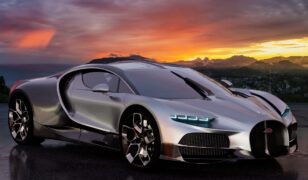
Unveiled at the 2026 Paris Motor Show, the Alfa Romeo Cuorerosso is a low, wide 2+2 coupé that combines a grand tourer’s character with a supercar’s shape. Just as important is what the car is not. Alfa Romeo stresses that Cuorerosso doesn’t preview any production model. It is a manifesto for the brand’s design, technology and performance philosophy, meant to inspire several future Alfa Romeos.
A 2+2 Coupé With Supercar Proportions
The Alfa Romeo Cuorerosso is 4,700 mm long, 1,980 mm wide and only 1,331 mm tall. Its wheelbase is 2,930 mm, while the automaker quotes a weight of 1,750 kg. The company also claims a drag coefficient of 0.28.
The body proportions are deliberately dramatic. The front is very low, the body is broad, and the roof flows toward a truncated rear end inspired by Alfa Romeo’s traditional Coda Tronca design.
The famous Alfa Romeo Scudetto shield remains central to the front design, but the concept car reinterprets it. The grille integrates small illuminated triangular elements, while the thin headlights form part of the wider Trilobo face.
At the rear, the window itself takes on a Scudetto-like shape, while two round taillights sit within the cut-off tail.
View this post on Instagram
Four Seats and Four-Door Access
Although Alfa Romeo calls the Cuorerosso a 2+2 coupé, it has four individual seats and rear-hinged back doors.
Conventional exterior door handles have also disappeared. Instead, the doors open via a roof-mounted touch control. That does not mean its unusual door mechanism will reach production. Features such as the rear-hinged doors remain very much in concept-car territory.
This makes the Cuorerosso more than a traditional two-seat supercar study. Alfa Romeo is exploring how sharp sports-car shapes could coexist with enough cabin space for four passengers.
The 2.9-Liter V6 Is Still Part of Alfa Romeo’s Future Vision
For performance car fans, the most important detail is under the hood.
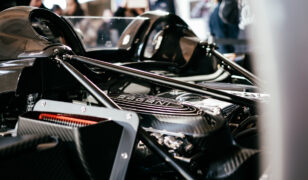
Alfa Romeo says its vision for a future flagship performance powertrain could combine a 2.9-liter V6 with a full-hybrid system, Q4 all-wheel drive, a torque-converter transmission, and a carbon-fiber driveshaft.
That 2.9-liter V6 is closely associated with Alfa Romeo’s modern Quadrifoglio performance models. The Cuorerosso also carries the Quadrifoglio badge, and its three driving settings include Cruise, Sport, and Quadrifoglio modes.
Alfa Romeo has not announced official horsepower or torque figures for the Cuorerosso, so treat any specific output discussed elsewhere as speculation for now.
The concept car also uses air suspension and Brembo carbon-ceramic brakes with Alfa Romeo calipers.
It Is Not Going to Be V6-Only
Cuorerosso does not signal that every future Alfa Romeo will use this engine.
The company is planning a multi-energy strategy. Future vehicles are being developed to support full-electric, plug-in hybrid, mild-hybrid and full-hybrid powertrains, depending on the model and market. Alfa Romeo says these future architectures will cover key market segments, with vehicles up to 4.7 meters long and the potential for Quadrifoglio variants.
This makes the hybrid V6 especially significant. Alfa Romeo shows that electric-powered cars don’t automatically mean abandoning combustion engines in its highest-performance cars.
A Driver-Focused Cabin Without a Giant Central Screen
The Cuorerosso’s cabin follows the same philosophy.
Instead of placing one huge tablet in the middle of the dashboard, Alfa Romeo has curated the interior around the driver. A long center console separates four individual seats, while the dashboard draws on both the original 1967 33 Stradale and its modern successor.
One of the main features is Alfa Romeo’s new Cannocchiale Vivente instrument system. In its Immersivo setting, it uses two separate displays in a layout inspired by Alfa’s traditional twin instrument binnacles. In Concentrato mode, the two elements physically move together to create a simpler central display with less information. The idea is to reduce distractions as driving becomes more focused.
The concept also uses steer-by-wire, although Alfa Romeo has retained physical and haptic controls around the steering wheel and center console. A separate control area called the Magma Display combines a touch surface with a rotary controller, driving-mode selector, and switches.
Alfa Romeo Calls the Design “Necessary Beauty”
Cuorerosso introduces a philosophy Alfa Romeo calls Bellezza Necessaria, or “Necessary Beauty.”
The idea is to remove unnecessary visual elements and make design, technology, and function work together. According to Alfa Romeo, its Centro Stile team spent a short period working on initial sketches before moving into three-dimensional development. Designers initially treated the body as a solid form without wheels, windows, or detailed exterior elements so they could concentrate on its proportions and surfaces.
The finished car wears a new Liquid Ink Red finish. Alfa Romeo says it uses a fine aluminum base covered by a transparent colored layer, allowing the body to shift from bright red toward much darker tones depending on the light and viewing angle.
Inside, materials include Poltrona Frau nubuck, metallic finishes, and regenerated leather containing 60% post-industrial waste from premium upholstery production. Alfa Romeo has also experimented with recycled carbon fiber combined with red resin.
Do Not Call It the Next Giulia Yet
The Cuorerosso’s size, four-seat layout and fastback-like shape naturally invite comparisons with a future Giulia. Some automotive publications have already made that connection.
Alfa Romeo itself is being much more careful.
The company explicitly says Cuorerosso is neither the direct preview of a production vehicle nor simply a styling exercise. Its purpose is to establish ideas that can carry over to future Alfa Romeos.
So it would be premature to call this the next Giulia, a new production supercar, or a confirmed future Quadrifoglio.
What it does show is more important: Alfa Romeo wants its future cars to remain low, distinctive and driver-focused where the segment allows, while giving its performance models access to electrified combustion power rather than committing exclusively to EVs.
What Comes Next
Alfa Romeo is presenting the Cuorerosso as its manifesto for the next generation of vehicles, rather than something buyers will soon find in a showroom.
Some ideas are clearly too extreme for mass production. Still, things such as the new front-and-rear design language, driver-focused displays, material choices, and a multi-energy approach are much more relevant to future road cars. Alfa Romeo has also indicated it could further develop its evolving digital interface through Stellantis’ STLA SmartCockpit technology.
For performance enthusiasts, the biggest message is simple. The Quadrifoglio philosophy is not disappearing.
If Alfa Romeo follows the direction set by Cuorerosso, its next generation of high-performance cars could combine the character of the 2.9-liter V6 with hybrid assistance, all-wheel drive, and new chassis technology, while keeping driving engagement at the center of the experience.