Boulder Concept Hints at Hyundai’s Serious Entry Into Hardcore Off-Roading
The fifth-largest automotive brand in the U.S., Hyundai is clearly aiming higher, and the Boulder looks like its most ambitious statement yet
Hyundai turned heads at the 2026 New York International Auto Show, pulling the cover off its Boulder Concept.
The concept not only previews the Korean automaker’s interest in off-road-focused SUVs, but also shows the brand’s likelihood to enter the truck and more capable utility-vehicle segments built specifically for the U.S. market.
Hyundai has never produced a body-on-frame vehicle before. Company officials confirmed that a production version is in development and will be designed, built, and assembled in the United States using American steel, with an expected arrival by 2030.
Styled at Hyundai’s Design North America studio in Southern California under a philosophy the team calls “Art of Steel,” the Boulder cuts an unmistakably aggressive silhouette. Its squared-off, upright body rides on massive 37-inch mud-terrain tires and is finished in a metallic shade dubbed Liquid Titanium.
Short overhangs, heavy-duty tow hooks, a low-profile roof rack, and a full-size spare tire mounted on the tailgate give the concept an uncompromising, trail-ready stance.
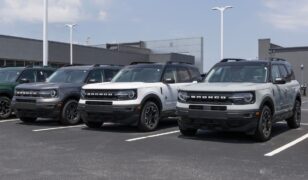
The design draws clear comparisons with segment dominators like the Ford Bronco, Jeep Wrangler, and Toyota 4Runner.
Among its more distinctive features is a double-hinged tailgate that swings open from either side, offering added flexibility when loading gear. Safari-style fixed upper windows let more natural light into the cabin, while coach-style rear-hinged doors lend the concept a dramatic flair — though whether these features survive into production remains to be seen.
Moving into the interior. Hyundai took a deliberate stand against the touchscreen-heavy trend dominating modern vehicles. The Boulder Concept might come with physical knobs, chunky switchgear, and a flat-bottom steering wheel dominating the dashboard.
Materials throughout the cabin seem durable, from reinforced grab handles to padded seat bolsters. Elements such as fold-out tray tables show that Hyundai is not planning to compromise practicality at all.
Hyundai has not confirmed what will power the Boulder. However, the company officially announced that it plans to introduce an EREV (Extended Range Electric Vehicle) powertrain—an electric system backed by a gasoline engine for additional range when the battery runs low.
Given Boulder’s size and off-road focus, that option appears to be a strong fit.
The Boulder reveal is not happening in isolation. Hyundai has been aggressively expanding its American manufacturing footprint, operating a long-running assembly plant in Alabama and a newer EV-focused Metaplant in Georgia. Affiliate Hyundai Steel recently announced plans for a $5.8 billion electric arc furnace mill in Louisiana.
The company, now celebrating 40 years in the American market, says it plans to introduce 36 new or refreshed vehicles by 2030, with 80 percent built domestically.