Meet the 5 Fastest Electric Cars on Earth in 2026

The fastest production car on the planet no longer runs on gasoline.
Electric hypercars have taken over the top of the speed charts. In September 2025, a Chinese-built electric car beat every gas-powered supercar ever tested for top speed, including Bugatti’s fastest model. That record marked a turning point. Electric power is no longer limited to efficient city cars and quiet luxury vehicles. The fastest electric hypercars now produce more than 2,000 horsepower and reach 60 mph in under two seconds.
Below are the 5 fastest all-electric cars in the world today, based on verified top-speed data, with acceleration figures included for each car. And one of them costs about as much as a nice house.
5. Pininfarina Battista

- Top speed: 222.5 mph (358.03 km/h)
- 0-60 mph: 1.79 seconds
- Horsepower: 1,900 hp
- Price ≈ $2.2 million
Pininfarina spent nearly a century designing cars for other manufacturers, including some of the most famous Ferraris ever built. The Battista is the company’s first car sold under its own name, built to prove a point.
During testing at India’s Natrax facility, the car reached 358.03 km/h, or 222.5 mph. The Federation of Motor Sports Clubs of India validated the result.
Its four electric motors produce roughly 1,900 horsepower and send the Battista from 0 to 60 mph in 1.79 seconds, verified at the Nardò test track in Italy.
Only 150 units will ever be built, and each one takes more than 1,250 hours to hand-assemble in Cambiano, Italy. For a company known purely for design work, the Battista is a genuine engineering achievement.
Prices officially start at €2.2 million, before taxes and optional customization.
4. Rimac Nevera
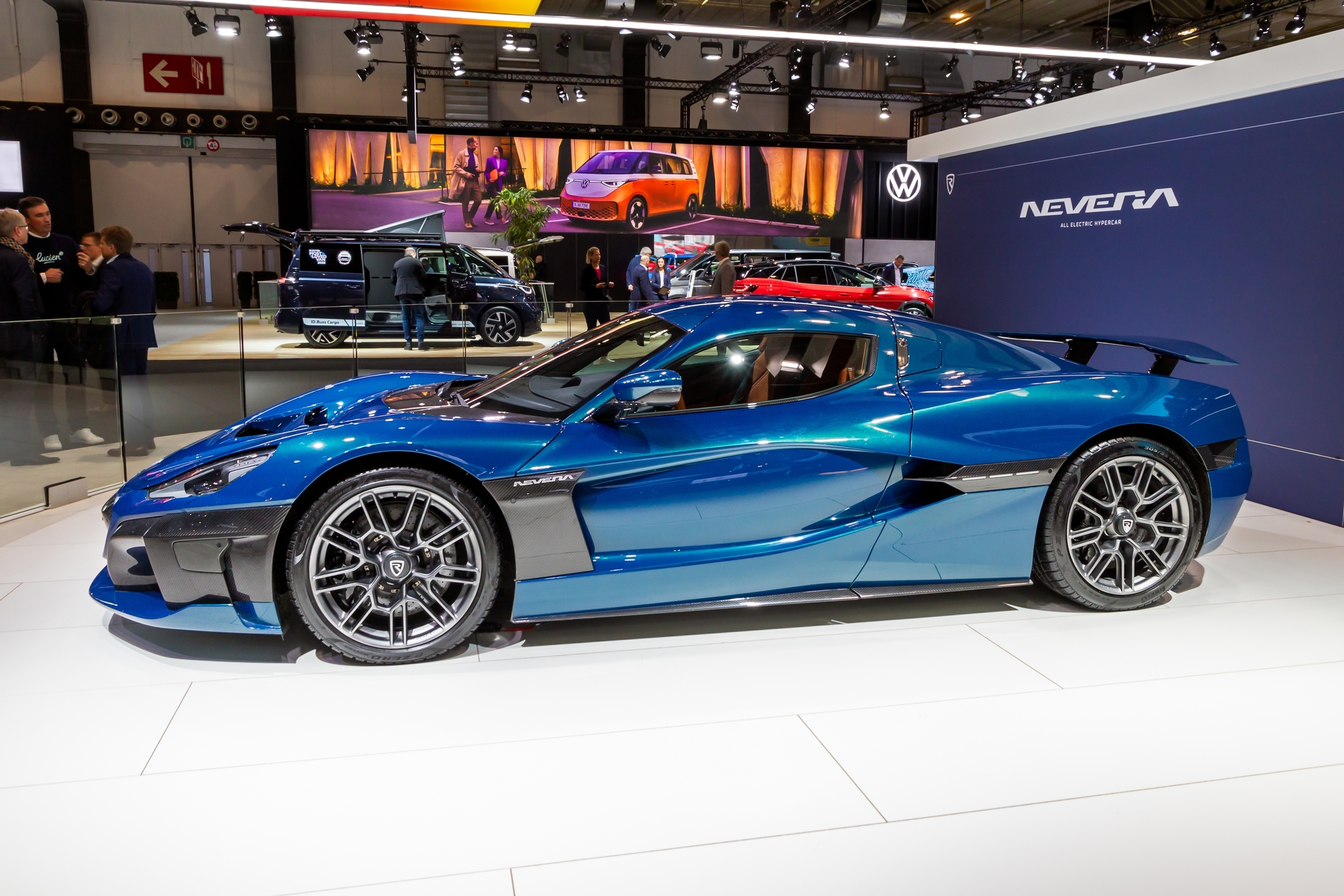
- Top speed: 256 mph (412 km/h)
- Battery capacity: 120 kWh
- 0-60 mph: 1.74 seconds
- Horsepower: 1,914 hp
- Price ≈ $2.2 million
The original Rimac Nevera proved that an electric production car could combine record-breaking acceleration with a top speed above 400 km/h.
During a high-speed drag at Papenburg, the Nevera reached 412 km/h. The speed was measured using a Racelogic VBOX GPS, and the car was fitted with road-legal Michelin Pilot Sport Cup 2R tires.
Its four electric motors produce a combined 1,914 horsepower. Each motor powers an individual wheel, allowing the car’s software to continuously adjust torque distribution.
Customer cars are normally limited to 352 km/h, or 219 mph. The peak 412 km/h capability is available only during controlled events with Rimac support. This restriction is necessary because tires must be carefully inspected and prepared before spinning at such extreme speeds. Production of the Nevera is limited to 150 units.
3. Aspark OWL

- Top speed: 256.6 mph (413 km/h)
- 0-60 mph: 1.72 seconds
- Horsepower: 1,953 hp
- Price ≈ €2.9 million
The Aspark OWL is a road-legal electric hypercar developed by Japanese engineering company Aspark and produced in Italy.
Aspark lists its maximum top-speed capability as 413 km/h, which converts to approximately 256.6 mph. However, the company also states that regular customer vehicles are electronically limited to 350 km/h for tire durability and safety.
This means the OWL’s 413 km/h figure is an official manufacturer-listed capability, not a documented top-speed run comparable to the grounded results of the Yangwang and Rimac models.
The OWL uses four electric motors and produces 1,456 kW of power. Aspark reports a 0-to-60 mph time of 1.72 seconds with a one-foot rollout and a 0-to-300 km/h time of 9.74 seconds.
Production is limited to 50 individually built cars. The car has also received road homologation in markets including Japan, confirming that it is more than an experimental prototype.
2. Rimac Nevera R

- Top speed: 268.2 mph (431.45 km/h)
- 0-60 mph: 1.66 seconds
- Horsepower: 2,107 hp
- Price ≈ $2.3 million
The Rimac Nevera R is a more aggressive, track-focused evolution of the original Nevera. It comes from a Croatian company that now also owns Bugatti, and the pedigree shows. This car holds 24 independently verified world records, more than any other production car in history. Its 0-60 mph time of 1.66 seconds is the quickest ever recorded for a road-legal vehicle.
During testing verified by Dewesoft, the Nevera R reached 431.45 km/h. It also accelerated from 0 to 400 km/h and stopped completely in 25.79 seconds. That was 4.14 seconds quicker than the previous record held by the standard Nevera.
Four electric motors provide a combined 2,107 horsepower. Rimac’s torque-vectoring system controls the power delivered to each wheel, helping the car maintain traction during hard acceleration.
The Nevera R also has a fixed rear wing, a larger diffuser, and a redesigned aerodynamic package. According to Rimac, these changes produce 15% more downforce while improving aerodynamic efficiency by 10%.
Only 40 vehicles are planned, with an official starting price of €2.3 million.
1. Yangwang U9 Xtreme

- Top speed: 308.4 mph (496.22 km/h)
- Horsepower: 3,000 hp
- Price ≈ $200,000
- Production: Limited to no more than 30 cars
The Yangwang U9 Xtreme currently holds the highest recorded top speed claimed for a production car of any powertrain type.
On September 14, 2025, professional driver Marc Basseng reached 496.22 km/h at the ATP Automotive Testing Papenburg facility in Germany. That number beat the previous record for any production car, gas or electric, which belonged to the Bugatti Chiron Super Sport 300+ at 304.8 mph.
The power comes from four high-speed electric motors, operating at up to 30,000 rpm. Together, they generate more than 3,000 PS, or about 2,959 horsepower.
The U9 Xtreme also uses an upgraded 1,200-volt electrical platform, a high-discharge lithium iron phosphate Blade Battery, and track-focused semi-slick tires. Yangwang confirmed that it would offer no more than 30 units to customers.
The Big Picture
Electric cars now compete at the highest level of production-car performance. The Yangwang U9 Xtreme has exceeded 300 mph, while models such as the Rimac Nevera R can reach 60 mph in less than two seconds.
Every car on this list is a production model built for customers, not simply a concept prototype. Most are rare and extremely expensive, but they clearly show what modern electric technology can achieve.