How to Read Tire Sidewall Numbers and Ratings
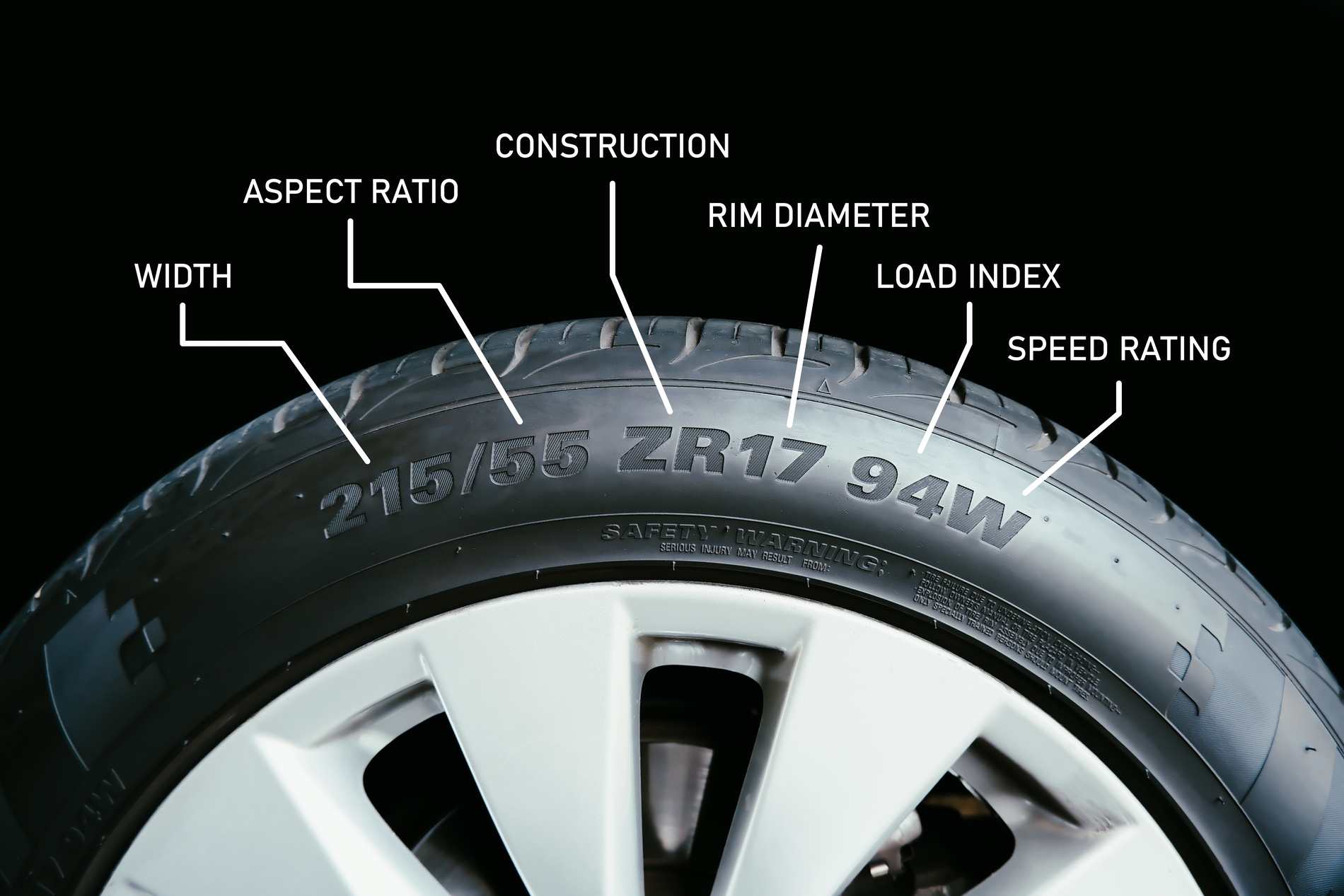
Every tire sidewall is a data plate. It carries the information about the tire’s size, how much weight it can hold, how fast it can safely go, when it was made, and how it will perform in rain, heat, and snow. Every number or letter has a meaning.
We’ll use P225/60R16 95H as our example throughout this guide. By the end, you’ll be able to decode any sidewall like you’ve been doing it for years.
Step 1: The Tire Type Prefix — The Letter Before the Numbers
What you may see: P, LT, ST, or T, or sometimes nothing at all.
This is the very first character on the sidewall, and it tells you what kind of vehicle the tire is built for.
- P = Passenger vehicle: Cars, SUVs, crossovers, minivans, light pickup trucks.
- LT = Light Truck: Built for heavier loads, towing, and payloads.
- ST = Special Trailer: Boat trailers, utility trailers, etc.
- T = Temporary: Skinny spare in your trunk for emergencies only.
- No prefix at all? That’s a Euro-metric tire. It’s sized slightly differently but works fine on most passenger cars.
Step 2: Section Width — The First Three Digits
225 in P225/60R16 95H
This number, measured in millimeters, is the tire’s width from sidewall to sidewall when properly mounted and inflated. In our example, 225 means the tire is 225 mm wide, approximately 8.9 inches.
The bigger the number, the wider the tire.
A wider tire puts more rubber on the road, which can improve traction and handling. But if you go too wide, you risk rubbing against your wheel well or messing with your vehicle’s steering geometry. Always stick close to what the manufacturer recommends.
Step 3: Aspect Ratio — The Two Digits After the Slash
60 in P225/60R16 95H
This number is the sidewall height of the tire, expressed as a percentage of the tire’s section width.
So in our example: 60% of 225 mm = 135 mm of sidewall height (about 5.3 inches).
Here’s what this means:
- Lower number (e.g., 35, 45) = shorter sidewall = sportier, better cornering, but a harsher, bumpier ride. It is common on sports cars.
- Higher number (e.g., 65, 70) = taller sidewall = more cushion, smoother ride, but not the best handling. It is common on trucks and SUVs.
Step 4: Construction Type — The Letter After the Aspect Ratio
R in P225/60R16 95H
This single letter tells you how the tire’s internal structure is built.
- R = Radial: This is what 99% of modern tires are made of.
- D = Diagonal: Older construction, still used on some trailers and vintage vehicles.
- B = Belted Bias: Rare, mostly phased out.
Unless you’re restoring a classic car or buying trailer tires, you’ll almost always see R.
Step 5: Rim Diameter — The Two Digits at the End of the Size Code
16 in P225/60R16 95H
This is the diameter of the wheel (rim) this tire is designed to fit, measured in inches. A 16 means you need a 16-inch rim. You can find your wheel size on the inside of your driver’s door jamb or in your owner’s manual.
Step 6: Service Description — Load Index and Speed Rating
95H in P225/60R16 95H
This two-part code tells you how much weight your tire can carry and how fast it can safely go.
1. Load Index (the Number — 95)
The load index is NOT a direct weight in pounds. It’s a code number on a standardized chart.
Here are common load index values and what they translate to:
| Load Index | Max Load Per Tire |
| 88 | 1,235 lbs |
| 91 | 1,356 lbs |
| 94 | 1,477 lbs |
| 95 | 1,521 lbs |
| 99 | 1,709 lbs |
| 104 | 1,984 lbs |
So a load index of 95 means each tire can carry up to 1,521 lbs at proper inflation. Multiply by 4 tires and your car is rated to carry 6,084 lbs total.
Pro tip: Never buy a replacement tire with a lower load index than your original equipment tire.
2. Speed Rating (the Letter — H)
The speed rating indicates the maximum sustained speed the tire can safely handle. Here’s a cheat sheet:
| Speed Rating | Max Speed |
| S | 112 mph |
| T | 118 mph |
| H | 130 mph |
| V | 149 mph |
| W | 168 mph |
| Y | 186 mph |
So our example tire with an H rating can sustain up to 130 mph.
Important: This doesn’t mean you should drive at that speed. It means the tire is tested to handle the heat generated at that speed safely.
Step 7: DOT Code — Your Tire’s ID and Birth Certificate
What you may see: Something like DOT U2LL LMLR 2524
The letters DOT stand for Department of Transportation. This marking confirms the tire meets U.S. federal safety standards.
The full DOT code is a sequence of up to 13 characters. For most consumers, only the last four digits matter.
The Last 4 Digits = Manufacturing Date
- First two digits = the week of the year (01 through 52)
- Last two digits = the year
Example: 2524 = 25th week of 2024 = tire manufactured around mid-June 2024.
Practical tip: Always check the DOT code when buying tires because a tire sitting in a warehouse for 4 years before being sold to you is already nearly halfway through its service life. And if you find a DOT code ending in only three digits, that tire was made before 2000. Get it off your car immediately.
Step 8: Winter/Snow Symbols — M+S and the Mountain Snowflake
What you may see: M+S and/or a mountain peak with a snowflake inside
M+S (Mud and Snow)
This label means the tire’s tread pattern has enough void space and aggressive edges to outperform a standard all-season tire in light snow and mud.
- It is good for light snow, wet roads, and occasional mud.
- Not a replacement for real winter tires.
3PMSF — Three-Peak Mountain Snowflake (the Mountain + Snowflake Icon)
A tire earns this symbol only after passing a standardized snow traction test set by the U.S. Tire Manufacturers Association (USTMA). It must outperform a reference all-season tire in severe snow conditions by a defined margin.
Step 10: Maximum Inflation Pressure
What you may see: Something like MAX PRESS 51 PSI (or shown in kPa)
This is the maximum air pressure the tire structure can safely contain, not the pressure you should drive on. Your correct tire pressure is printed on the sticker inside your driver’s door jamb or in your owner’s manual.
Quick Reference Cheat Sheet
Here’s how to decode P225/60R16 95H from left to right:
| Code | What It Means |
| P | Passenger vehicle tire |
| 225 | 225 mm wide (sidewall to sidewall) |
| 60 | Sidewall height = 60% of 225 mm |
| R | Radial construction |
| 16 | Fits a 16-inch rim |
| 95 | Load index = 1,521 lbs per tire max |
| H | Speed rating = max 130 mph sustained. |
And on the rest of the sidewall:
| Marking | What It Means |
| DOT + last 4 digits | Manufacturing date (week + year) |
| M+S | Light mud/snow capable tread pattern |
| Mountain snowflake | Tested for severe snow conditions |
| MAX PRESS 51 PSI | Maximum safe inflation (NOT your target) |